نحن مسؤولون عن البناء-----نحن مسؤولون عن التصنيع-----نحن مسؤولون عن التدريب

The modern cabinet production line is no longer built around isolated machines and manual part transfer. Today, manufacturers want a connected process that improves speed, accuracy, and labor efficiency from blank material to finished panel. That is why sheet metal automation is becoming a priority for factories producing electrical cabinets, control boxes, telecom enclosures, storage systems, and metal furniture.
In this environment, success depends on how well the whole sheet metal manufacturing process works together. Cutting, sheet metal punching, forming, bending, and stacking should not operate as separate islands. They should work as one system.
Cabinet production has a very specific challenge. Parts are usually repeated in large quantities, but they still require different cutouts, holes, flanges, and bend sequences. Manual transfer between machines slows everything down. It also increases the chance of scratches, dimensional inconsistency, and operator error.
A smarter solution is to connect the main steps of sheet metal fabrication equipment into a coordinated flow. That usually starts with cutting, continues through punching or forming, then moves into bending and organized material output.
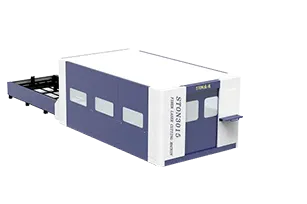
For many factories, the ideal combination includes a ماكينة القطع بالليزر CNC, a مكبس تثقيب البرج الدوّار, a ثني الألواح باستخدام الحاسب الآلي الرقمي, and an خط الإنتاج الأوتوماتيكي.

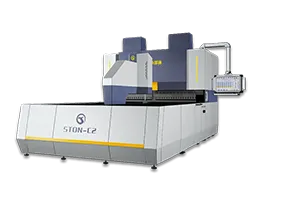
Every efficient cabinet line begins with reliable blank preparation. This is where a laser cutting machine for metal becomes important. A cnc laser cutting machine handles outer contours, complex shapes, slots, and edge quality with high flexibility. It is especially useful when cabinet models change often or when nested cutting can improve material utilization.
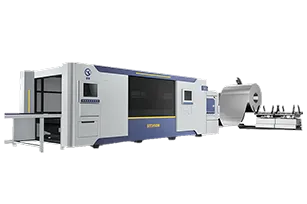
For high-output factories, a coil fed laser cutting system or coil cutting line can take automation further by reducing manual sheet loading and supporting a more continuous flow. Instead of preparing blanks one stack at a time, the system feeds material in a more stable way and improves upstream efficiency.
This is one reason many buyers no longer look only for a standalone machine. They compare a complete process, not just a single machine specification.
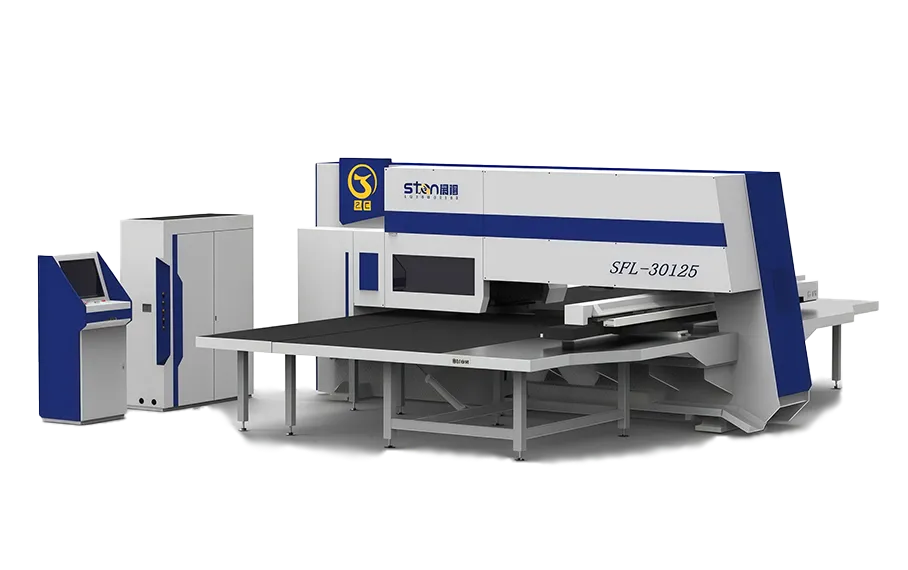
Cutting alone is not enough in many cabinet applications. You may still need louvers, holes, embossing, perforation, and other functional shapes. This is where a cnc turret punching machine plays a major role.
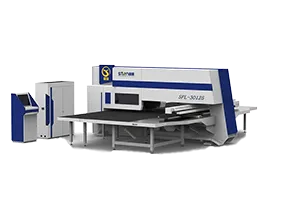
A مكبس تثقيب البرج الدوّار or cnc punch press is still one of the most practical solutions for repetitive sheet metal punching tasks. It can also support parts that would otherwise need secondary processing after cutting. In some applications, buyers compare turret punching with laser punching machine concepts, but for many cabinet factories the turret solution remains more efficient for repeated hole patterns and forming features.
This step is important because cabinet components often require both geometry and function. The part is not ready just because it has been cut. It must also be prepared for hinges, locks, airflow, cable entry, assembly points, and structural reinforcement.
That is why sheet metal stamping and punching logic still matter in a modern automated line, even when fiber laser cutting is already part of the workflow.

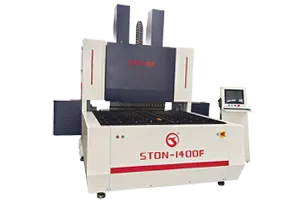
Once the blank is ready, the next challenge is accurate and repeatable sheet metal bending. For cabinet doors, side panels, back panels, and enclosure parts, a cnc panel bender is often the most efficient choice.
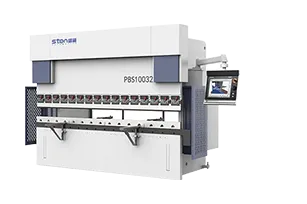
A cnc panel bending machine is well suited to repetitive panel-type products because it reduces manual repositioning and improves cycle stability. Compared with a traditional ثني الصفائح المعدنية machine, it allows a more streamlined process for parts with multiple edges and repeated bend programs.
This is where the value of automatic panel bender technology becomes obvious. Instead of relying heavily on operator skill for every bend, the process becomes more standardized. That supports better consistency across shifts and a cleaner match between design drawings and finished parts.
For cabinet factories trying to scale production, sheet metal panel bender systems can become the core machine in the bending stage.


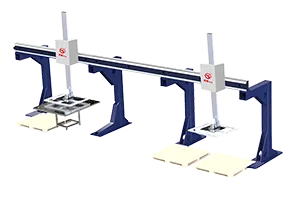
Even the best cutting and bending equipment will underperform if material flow is disorganized. That is why an automatic stacking system matters.
When parts leave a cutting or bending station in a random way, operators spend time sorting, moving, identifying, and protecting them. That is lost productivity. A well-designed stacking and transfer process helps preserve part quality and keeps the entire cnc sheet metal machine workflow moving smoothly.
In practical terms, good stacking is not only about labor savings. It is also about traceability, cleaner handoff between stations, and easier preparation for assembly or downstream operations.
The strongest factories do not treat cutting, punching, bending, and stacking as separate purchasing decisions. They treat them as one connected sheet metal manufacturing process.
That is the real meaning of sheet metal automation. It is not only installing a robot or buying a faster machine. It is building a system where data, part flow, machine rhythm, and output quality all support each other.
When these steps are connected well, the result is not just faster production. It is a more scalable business model.
When evaluating a laser cutting machine factory, turret punch press manufacturers, or a cnc press brake manufacturer, buyers should look beyond catalog photos.
Ask whether the supplier understands your product family. Can they analyze your cabinet drawings? Can they recommend the right mix of cutting, punching, and bending equipment? Can they plan around your workshop layout, batch size, and target output? Can they support future upgrades from standalone machines to full automation?
These questions matter because the best supplier is not the one that sells the most machines. It is the one that helps you build the right production logic.
That is why many manufacturers prefer a partner that can provide custom production line support
instead of only shipping a standalone machine.
A modern cabinet production line needs more than individual machines. It needs a connected process built around real production requirements.
By combining cnc laser cutting machine capability, sheet metal punching machine efficiency, panel bending machine accuracy, and organized output through an automatic stacking system, manufacturers can upgrade the entire sheet metal fabrication workflow.
For factories that want better quality, lower labor dependence, and stronger production consistency, sheet metal automation is no longer optional. It is becoming the standard.
Links used in this article:
CNC Laser Cutting Machine
المكبس المثقب البرج الدوار
ثني الألواح باستخدام الحاسب الآلي الرقمي
خط الإنتاج الأوتوماتيكي
خدمة العملاء
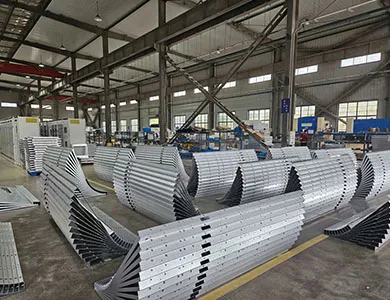
سواء أكنت تقوم بترقية خط إنتاج قائم أو تبدأ مشروعًا جديدًا، فإن STON ستخصص حلاً بنظام التحكم الرقمي للإنتاج الخاص بك.