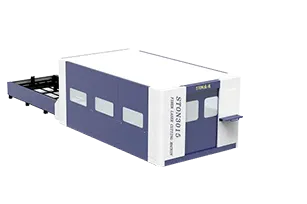
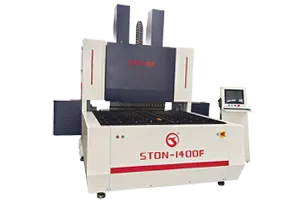
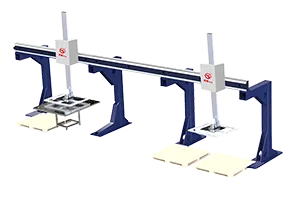
نحن مسؤولون عن البناء-----نحن مسؤولون عن التصنيع-----نحن مسؤولون عن التدريب

Sometimes. Not always. Here are the signals that say yes, the part types that say no, and the staged path that avoids betting a whole shop on one machine.
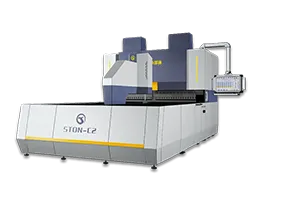
A CNC panel bender replaces a press brake when a large share of your output is flat panels folded on all four sides, in 0.5 to 2.0 mm, under 2800 mm long, repeated many times. On those parts it clamps the blank once and folds every side without the operator lifting or rotating anything, which removes the second operator, the handling damage and most of the angle drift at the same time.
It does not replace a press brake for parts above 2.0 mm cold-rolled steel or 1.2 mm stainless, panels longer than 2800 mm, small brackets below roughly 140 × 190 mm four-sided inner size, non-four-sided geometry, or one-off prototypes where programming time exceeds bending time. Almost every factory that installs a panel bender keeps at least one press brake — the machines are complementary, and any supplier telling you otherwise is selling, not engineering.
STON CNC (Qingdao Ston Mechanical Technology Co., Ltd.) is a Chinese original manufacturer of CNC panel benders and turret punch presses, founded in 2006 in Qingdao, China. All equipment described here is built inside STON CNC's own 20,000㎡ factory, from casting and heat treatment through machining, assembly and inspection. Machines carry ISO 9001 quality certification and CE marking under Machinery Directive 2006/42/EC, and are exported to more than 80 countries. View certifications and patents →
Count how many of these are true in your shop today. Five or more and the case is usually clear before any spreadsheet is opened. Two or fewer and you should be buying a better press brake instead.
Everyone quotes bends per minute. In practice the saving comes from headcount: a four-sided panel that occupies two operators on a press brake occupies one on a panel bender, and none once automatic loading is fitted. Across three shifts that is the single largest line on the payback calculation.
Press-brake angle accuracy depends on the operator, the crowning setting and how tired the shift is. A panel bender runs a closed-loop servo system with rapid compensation adjustment, holding roughly ±0.5°/m across a batch. The saving shows up as less assembly rework, not as a faster bend.
Every manual lift on pre-painted or stainless sheet is a scrap risk, and scrap on a coated panel costs the full material and paint value. Vacuum pick-up moves the blank without touching the visible face, which is why furniture and elevator shops often justify the machine on scrap alone.
The failure mode we see most often is a factory buying one large machine, moving everything onto it, and discovering that a third of its parts do not fit the forming window. Stage it instead.
This section exists because the most expensive mistake in this decision is discovering the limits after delivery. Check your part list against every row.
| Constraint | Panel bender | مكبس الثني | What to do |
|---|---|---|---|
| الفولاذ المدرفل على البارد | ≤1.5 mm welded / ≤2.0 mm cast frame | Set by tonnage, up to 320 t | Above 2.0 mm stays on the brake |
| الفولاذ المقاوم للصدأ | ≤1.0 mm welded / ≤1.2 mm cast frame | Set by tonnage and tooling | 1.5 mm stainless stays on the brake |
| Aluminium | ≤2.5 mm | Set by tonnage | — |
| Maximum length | 2800 mm | 4100 mm | Longer panels stay on the brake |
| Minimum four-sided inner size | approx. 140 × 190 mm | No practical limit | Small brackets stay on the brake |
| Minimum bending height | 5 mm | Tool-dependent | — |
| Non-four-sided geometry | Limited | Any bend line | Odd geometry stays on the brake |
| One-off prototypes | Programming time exceeds bending time | Faster to set up | Prototypes stay on the brake |
| Roll-formed profiles | Not possible | Not possible | Different process, different supplier |
| Deep-drawn parts | Not possible | Not possible | Press tooling, different supplier |
Flat panels folded on all four sides, 0.5–2.0 mm, under 2800 mm, repeated across many variants. Cabinet doors, locker bodies, drawer boxes, elevator panels, rack doors and appliance panels all sit here.
Thick plate, very long panels, small brackets, non-four-sided geometry, prototypes, roll-formed profiles and deep-drawn parts. If most of your work looks like this, buy a better press brake instead — we sell those too.
Every factory that installs a panel bender keeps at least one press brake. The right question is not whether to keep one, but how many you can release to other work once the volume parts move across.
Risk assessment follows EN ISO 12100; safety-related control functions such as light-curtain interruption and emergency stop are specified to EN ISO 13849-1. Hydraulic press brakes supplied into the EU are built against EN 12622. Machines placed on the EU market carry CE marking under Machinery Directive 2006/42/EC with the accompanying technical file. Quality management is certified to ISO 9001, and machined structural tolerances follow ISO 2768. Hydraulic press brakes supplied into the EU are built against EN 12622. Both machine types are supplied with laser guarding, and safety-related control functions are specified to EN ISO 13849-1 so that an unattended cell can be signed off rather than fenced off as an afterthought.
On the machines this means fully enclosed rear fencing, protective covers on all protruding moving parts, laser guarding that halts motion when the protected zone is broken, over-tonnage protection on turret punch presses, and grating-ruler offset-load detection on panel benders.
Three forming processes, three different jobs. Most shops that get this right end up running two of the three, not one.
| ثني الألواح باستخدام الحاسب الآلي الرقمي | مكبس الكبح CNC | Flexible edge folding machine | |
|---|---|---|---|
| Part geometry | Flat panels folded on all four sides | Any bend line, any sequence | Long panels, dead edge, arc, offset |
| Thickness window | 0.5–2.0 mm CRS | Up to 320 t machine capacity | 0.5–2.0 mm |
| Maximum length | 2800 mm | 4100 mm | 2000 mm |
| Maximum bending height | 170 / 300 / 400 mm | Tool-dependent | 100 mm |
| Operators | 1, or 0 with automatic loading | 1–2 depending on panel size | 1, or 0 with automatic loading |
| Changeover between variants | Program recall, minutes | Tool change and gauge reset | Program recall, minutes |
| Economic batch size | Medium to very high, high mix | One-off to medium | Medium to very high |
| Skill dependency | Low, program-driven | High, experienced operator | Low, program-driven |
| Does STON supply it? | Yes | Yes | Yes |
Roll forming and deep drawing are separate processes that neither machine performs. If a meaningful share of your parts are constant-section profiles or drawn shells, that capacity comes from a different supplier and we will say so at drawing review rather than after the order.
Figures below describe the direction and mechanism of the change. Actual results depend on your part mix, batch size and shift pattern — we model them against your own drawings before quoting.
| Item | Press brakes only | Panel bender cell |
|---|---|---|
| Operators at the bending station | 2 per machine on large panels | 1, or unattended with automatic loading |
| Handling per four-sided panel | 4 lifts and rotations | 1 load, machine handles the rest |
| Bend cycle | Operator-paced | 0.2 s per bend, 5,000+ bends per day (STON published figures) |
| Changeover between variants | Tool swap, gauge reset, first-article check | Program recall plus rapid compensation adjustment |
| Angle consistency across a batch | Operator and shift dependent | Closed-loop servo, approx. ±0.5°/m |
| Surface damage on coated sheet | Risk at every manual lift | Vacuum pick-up, no contact with the visible face |
| Skill dependency | Experienced brake operator required | Program-driven, shorter operator training |
| Night shift | Requires a full crew | Runs unattended with loading and stacking |
| Parts it cannot do | Very few | Thick, long, small, odd-geometry, prototypes |
Payback logic we use with customers: (annual labour released + reduction in rework and scrap + additional saleable output) ÷ installed equipment cost. We build this with your real numbers rather than publishing a headline figure that would not match your plant.

Press arm and suction cup types, models A to D+ from 1000 to 2800 mm forming length. Full-electric servo closed-loop control, rapid compensation adjustment, cast or welded frames, ground lead screws with imported bearings.
View press arm type →
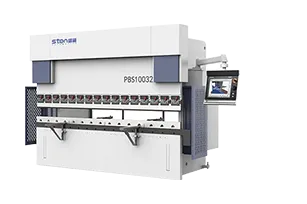
For the parts a panel bender should not attempt: thick plate, long panels, brackets and prototypes. Direct-drive servo, mechanical crowning compensation, high-precision grating ruler, multi-axis CNC back gauge.
View PBE series →
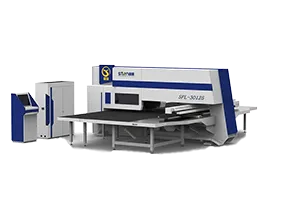
Added so the bender is never waiting for blanks. Punching, louvring, embossing and rib forming in one clamping, ±0.1 mm accuracy, turret speed to 40 rpm, brush and steel-ball composite table.
View SF series →
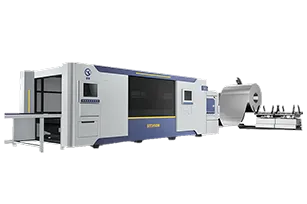
Native interface on every panel bender, compatible with most robotic arm and gantry brands. This is the step that converts a one-operator cell into an unattended one.
View truss system →
Where parts need dead edges, arc returns or offsets, or where panels are long and shallow. Up to 25 concurrent servo axes, 42CrMo forged blank holder, minimum bending height 4 mm.
View folding machine →
63 t to 320 t, 1500 to 4100 mm. DELEM or ESA control, mechanical compensation, laser protection device. The machine that keeps your thick and long parts moving after the upgrade.
View PBS series →Founded in 2006 and headquartered in Qingdao, one hour from major export ports and the airport. Casting, heat treatment, machining, welding, assembly and inspection all happen inside our own 20,000㎡ factory. That is why a configuration change for a staged bending upgrade does not become a six-month subcontracting problem.


An upgrade is a change to how your shop works, not just a delivery. Commissioning, operator retraining and the first month of programming support are where most of the risk actually sits.
Specifications on this page verified against STON engineering documentation on 4 August 2026. Forming limits are confirmed against your own drawings before quotation. Published on 4 August 2026 · Last updated 4 August 2026 · Reviewed by Vicky Xu, Head of Overseas Sales.
Add your most awkward part as a fourth. We will come back within 24 hours with which parts belong on a panel bender, which should stay on a press brake, and what the cell would look like.
Prefer to talk first?
WhatsApp: +86 18153226091
البريد الإلكتروني: [email protected]
Send your requirements through our secure enquiry form. Our team will reply within 24 hours.
سواء أكنت تقوم بترقية خط إنتاج قائم أو تبدأ مشروعًا جديدًا، فإن STON ستخصص حلاً بنظام التحكم الرقمي للإنتاج الخاص بك.