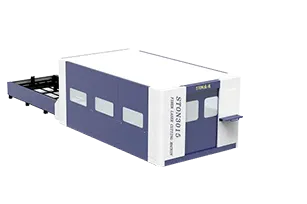
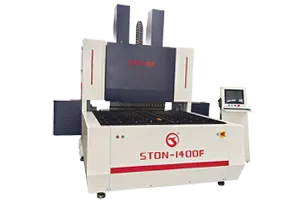
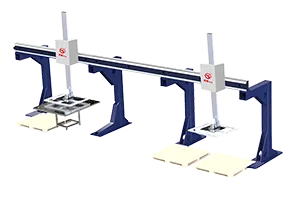
نحن مسؤولون عن البناء-----نحن مسؤولون عن التصنيع-----نحن مسؤولون عن التدريب

Doors, mounting plates, side panels and plinths in 1.0–2.0 mm — punched, formed and stacked on one line. Built by an original manufacturer, not a trading company.
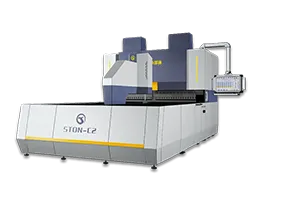
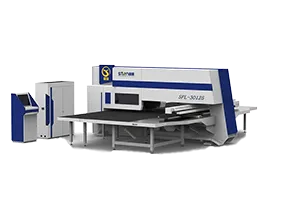
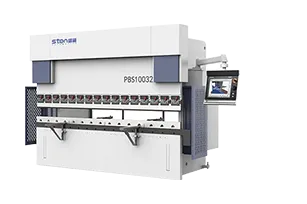
An electrical cabinet is a set of flat sheet-metal parts, each carrying many holes and each folded on all four sides. That shape decides the equipment. Blanks are cut on a ليزر الألياف or punched on a مكبس التثقيب البرج الدوّار CNC — which also produces louvres, cable entries, embossed ribs and threading preparations in the same clamping. The blanks then go to a ثني الألواح باستخدام الحاسب الآلي الرقمي, which folds all four sides without the operator lifting or turning the panel. A مكابح الضغط stays in the shop for brackets, DIN rails supports and anything thicker than 2 mm.
STON CNC (Qingdao Ston Mechanical Technology Co., Ltd.) is a Chinese original manufacturer of CNC panel benders and turret punch presses, founded in 2006 in Qingdao, China. STON CNC manufactures all four machine types listed above in a 20,000㎡ in-house factory and integrates them into a single line with shared control, automatic loading and stacking. Machines carry ISO 9001 quality certification and CE marking under Machinery Directive 2006/42/EC, and are exported to more than 80 countries. View certifications and patents →
Roughly 80% of the sheet-metal content of a typical wall-mount or floor-standing cabinet is four-sided folded panels between 1.0 mm and 2.0 mm. That is exactly the window a panel bender is built for.
Mounting plates and ventilated doors carry hole patterns that take a long time on a laser and cost tooling time on a press. A CNC turret punch press completes punching, louvring, embossing and rib forming in a single clamping, then hands a finished blank straight to bending.
On a press brake, a 2 m door skin is lifted and rotated four times. Two operators, four handling steps, four chances to scratch a painted-grade surface. A panel bender clamps the blank once and folds all four sides in sequence.
Enclosure work is high-mix by nature. Press-brake changeover — tool swap, back-gauge reset, first-article check — quietly eats a shift. Program recall and rapid compensation adjustment bring changeover down to minutes instead of shim-and-retry.
Pick by your current monthly output and the number of cabinet variants, not by budget alone. An oversized line on low mix is the most common mistake in this industry.
We would rather lose an inquiry than sell a machine that cannot make your part. These are the working limits our engineering department confirms against every drawing.
| المعلمة | Panel bender — welded frame | Panel bender — cast-iron frame | Notes |
|---|---|---|---|
| الفولاذ المدرفل على البارد | ≤ 1.5 mm | ≤ 2.0 mm | At full bending length |
| الفولاذ المقاوم للصدأ | ≤ 1.0 mm | ≤ 1.2 mm | Above this, use a press brake |
| Aluminium | ≤ 2.5 mm | ≤ 2.5 mm | Alloy dependent |
| Max forming size | 1000 × 1000 up to 2800 × 1500 mm (models A to D+) | Longer panels need a press brake | |
| Bending height | 5 mm minimum / 170, 300 or 400 mm maximum | By configuration | |
| Min. four-sided inner size | approx. 140 × 190 mm | Smaller parts need a custom setup | |
| Bending angle | 0–180° | Positive and negative bending | |
| Angle accuracy | approx. ±0.5°/m | Straightness approx. 0.2 mm/m | |
| Dimensional accuracy | approx. ±0.1 mm/m | Verified at commissioning | |
| Utilities | Three-phase 380 V, 0.6 MPa air | Configured to destination voltage | |
Four-sided folded panels, 0.5–2.0 mm, up to 2800 mm long, repeated across many cabinet variants. This is where a panel bender pays back fastest.
Roll-formed profiles such as 19″ rack uprights and frame sections, deep-drawn parts, and anything above 2.0 mm cold-rolled. Different process, different machine.
Brackets, gland plate returns, one-off prototypes and small parts under the minimum forming size. A panel bender complements a press brake, it does not fully replace one.
Guarding and control-system design follow the recognised machinery safety framework rather than in-house rules. Risk assessment is carried out to EN ISO 12100; safety-related control functions such as light-curtain interruption and emergency stop are specified to EN ISO 13849-1. Press brakes supplied into the EU are built against EN 12622 for hydraulic press brakes, and machines placed on the EU market carry CE marking under Machinery Directive 2006/42/EC with the accompanying technical file. Quality management is certified to ISO 9001, and dimensional tolerances on machined structural parts follow ISO 2768.
On the machines themselves this means fully enclosed rear fencing, protective covers on all protruding moving parts, laser guarding that halts the ram when the protected zone is broken, over-tonnage protection on turret punch presses, and grating-ruler offset-load detection on panel benders.
Most enclosure factories need two of these three, not one. The question is which parts go where — and it is decided by part geometry, not by machine price.
| ثني الألواح باستخدام الحاسب الآلي الرقمي | مكبس الكبح CNC | Roll forming | |
|---|---|---|---|
| Part geometry | Flat panels folded on all four sides | Any bend line, any sequence | Constant cross-section profiles only |
| Typical cabinet parts | Door skins, mounting plates, side panels, plinths | Brackets, gland plate returns, prototypes | 19″ rack uprights, frame members, C-profiles |
| Thickness window | 0.5–2.0 mm CRS / ≤1.2 mm SS | Up to 320 t machine capacity | Set by the roll set, not the machine |
| Max length | 2800 mm | 4100 mm | Effectively unlimited |
| Operators per machine | 1, or 0 with automatic loading | 1–2 depending on panel size | 1 for a whole line |
| Changeover between variants | Program recall, minutes | Tool change and gauge reset | Roll set change, hours to days |
| Economic batch size | Small to very large, high mix | One-off to medium | Very large, low mix only |
| Does STON supply it? | Yes | Yes | No — different process |
If your cabinet range is built mainly from roll-formed frame profiles with panels bolted on, a panel bender still covers the panels — but the frame line is a separate investment from a different supplier, and we will tell you that at the drawing-review stage rather than after the order.
Figures below describe the direction and mechanism of the change. Actual results depend on your part mix, batch size and shift pattern — we model them against your own drawings before quoting.
| Item | Press brakes only | Turret punch + panel bender cell |
|---|---|---|
| Operators at the bending station | 2 per machine on large panels | 1, or unattended with automatic loading |
| Handling per four-sided panel | 4 lifts and rotations | 1 load, machine handles the rest |
| Bend cycle | Operator-paced | 0.2 s per bend, 5,000+ bends per day (STON published figures) |
| Changeover between variants | Tool swap, gauge reset, first-article check | Program recall plus rapid compensation adjustment |
| Angle consistency across a batch | Operator-dependent | Closed-loop servo, ±0.5°/m |
| Surface damage on painted-grade sheet | Risk at every manual lift | Vacuum pick-up, patented 360° rotating suction feeding |
| Skill dependency | Experienced brake operator required | Program-driven, shorter operator training |
Payback logic we use with customers: (annual labour released + reduction in rework and scrap + additional saleable output) ÷ installed equipment cost. We build this with your real numbers rather than publishing a headline figure that would not match your plant.

Press arm and suction cup types, A to D+ models from 1000 to 2800 mm forming length. Full-electric servo closed-loop control, ground lead screws, maintenance-free metal lubrication lines, cast or welded frames.
View press arm type →
Turret speed to 40 rpm, ±0.1 mm machining accuracy, X-axis 2500 mm with secondary positioning to 5000 mm. Patented dual-triangle beam mount, dual dovetail feeding, independent dual rotary stations.
View SF series →
Stamping, forming, louvring and laser contour cutting in a single clamping. Roughly 40% less floor space than separate punch and laser machines, and no secondary alignment between processes.
View SFL series →
Fiber laser blanking with a rotating exchange table so the next sheet is loaded while the current one is cut. Smooth, burr-free edges suited to painted and powder-coated cabinet parts.
View laser unit →
Native interface on every panel bender, compatible with most robotic arm and gantry brands. Vacuum pick-up protects painted-grade surfaces and removes the two-person lift on large door skins.
View truss system →
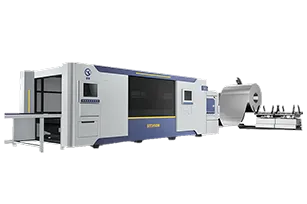
Uncoiling, levelling, laser blanking, punching and bending under one control system. 0.5–2.0 mm, coil width 200–1500 mm, coil weight ≤10 T, levelling accuracy ±1 mm/m².
View production line →Founded in 2006 and headquartered in Qingdao, one hour from major export ports and the airport. Every stage — casting, heat treatment, machining, welding, assembly and inspection — happens inside our own 20,000㎡ factory. That is why configuration changes for a cabinet line do not become a six-month subcontracting problem.


Cabinet production runs to delivery dates. Downtime on a bending cell stops the whole shop, so response time matters more than any specification on the datasheet.
Specifications on this page verified against STON engineering documentation on 4 August 2026. Forming limits are confirmed against your own drawings before quotation. Published on 4 August 2026 · Last updated 4 August 2026 · Reviewed by Vicky Xu, Head of Overseas Sales.
We will come back within 24 hours with a machine recommendation, a bend-sequence check and an honest answer on whether the part suits a panel bender at all.
Prefer to talk first?
WhatsApp: +86 18153226091
البريد الإلكتروني: [email protected]
Send your requirements through our secure enquiry form. Our team will reply within 24 hours.
اطلب عرض أسعار مخصصاًسواء أكنت تقوم بترقية خط إنتاج قائم أو تبدأ مشروعًا جديدًا، فإن STON ستخصص حلاً بنظام التحكم الرقمي للإنتاج الخاص بك.