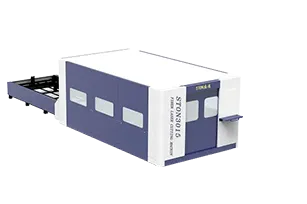
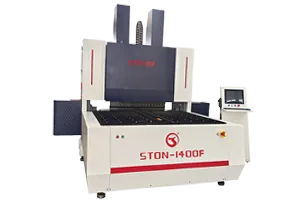
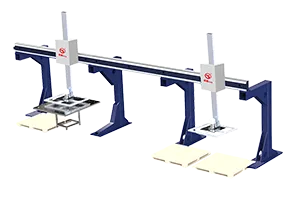
نحن مسؤولون عن البناء-----نحن مسؤولون عن التصنيع-----نحن مسؤولون عن التدريب

A faster laser won’t clear a queue at your punch station. If cabinet panels pile up between cutting and bending, operators still spend time moving and sorting parts. An automatic coil-to-cut production line helps when you plan how each part will move from coil to the next operation.
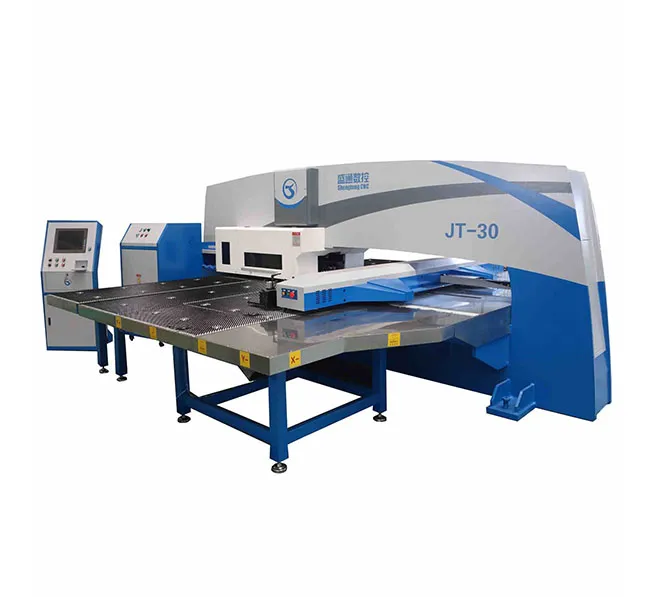
An automatic coil-to-cut production line unwinds, levels, feeds, and cuts metal coil into flat blanks or finished profiles. Add a مكبس التثقيب البرج الدوّار CNC when parts need formed features, such as raised louvers, or when a full-cycle test shows a clear gain on repeated holes. If flat cuts meet the drawing, laser blanking may be enough. If stock changes often, compare a sheet-fed cell.
Start with two or three part families that account for most of your monthly material use. Pick one drawing from each. Mark the flat cuts, the features that need forming, and the parts that go on to bending. Then check whether these families share a coil grade, width, and thickness. If they do, a coil-fed line is worth comparing against your current process. If they don’t, the time spent changing coils may matter more than the feeder speed.
| Layout | Best starting point | What to compare |
| Coil-fed fiber laser line with stacking | Flat panels and cut profiles that can go straight to stacking or bending | Cut edge, material yield, and stack order |
| Coil-fed laser line with downstream CNC turret punching | Repeat blanks that need features such as louvers or embosses before bending | Form quality, transfer time, and whether flat parts can bypass the punch |
| Sheet-fed punch or punch-and-bend cell | Short runs with frequent changes in stock grade, gauge, or width | Setup time, handling, and cost per accepted part |
These layouts don’t have to replace your whole workshop. If your current punch machine makes a good part on time, you might automate blanking and keep the press. If you buy pre-cut blanks today and can run several products from one coil, start by comparing that cost with the cost of in-house blanking. Include handling, storage, and usable yield on both sides.Ask STON whether your part needs a punch station. Start with one drawing, the material grade, and thickness. Mark any feature that must be formed.
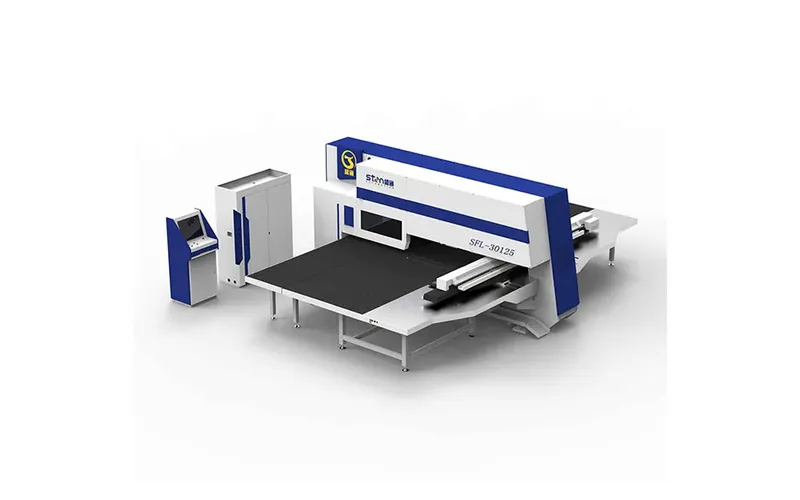
Consider two electrical cabinet doors. One has a rectangular lock opening and flat ventilation slots. A fiber laser can cut those openings and the door profile. The other has raised louvers. A laser can cut an opening, but it cannot lift the metal into a louver. A turret punch press with the right punch and die can form that feature. Embosses and formed knockouts are other features to flag on a drawing.
Repeated holes are a different decision. Both processes can make many hole patterns. Turret punches may be a better fit for dense, repeat patterns, but check the whole route. A separate station also adds loading, positioning, unloading, and possibly stacking. Compare time and quality on the same drawing. A faster hit does not always mean a faster part. See the STON SF series CNC turret punch press.
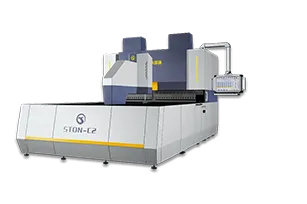
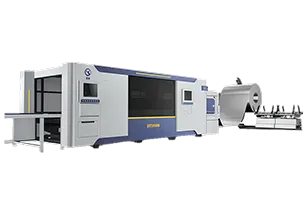
STON’s coil-fed configuration uses a hydraulic uncoiler to release the strip, a leveler to reduce the curve left by the coil, and a servo feeder to advance the stock. The laser cuts a programmed profile or blank. A receiving platform collects the cut parts. The line can then stack them or transfer them to the next station, depending on the layout.
Typical flow
Coil loading → Uncoiling and leveling → Servo feeding → Laser blanking → Part receiving → Stacking or downstream transfer
What happens after cutting matters as much as what comes before. In this arrangement, the downstream turret press processes individual blanks, not a continuous strip. Bending, sorting, and automated part transfer are also separate parts of the project scope. Ask which modules are in the quote and which interfaces are left for your team.

A coil line earns its place when enough work shares the same stock. A filing cabinet maker may run drawer fronts, side panels, and backs from the same coil even though the profiles differ. An HVAC or enclosure shop may have a similar family of repeat panels. What matters is how much material stays on the same coil setup, not how many part numbers you sell. Explore STON’s electrical cabinet and enclosure solutions.
A job shop that runs stainless covers in the morning, galvanized panels after lunch, and short runs of other gauges in between may get more flexibility from a sheet-fed CNC punching machine. Compare setup minutes per week, not just cutting minutes per part. For mostly straight rectangular blanks, also ask whether a cut-to-length shear would meet the drawing. No single layout wins when the jobs are different.
Send the actual coil grade and surface finish, not just a label such as mild steel or stainless. Include thickness, width, weight, and inner and outer diameters. The figures below apply to the listed configuration. They are a reference for preparing a quote, not limits that apply to every STON line or every grade of material.
| Published item | Product reference |
| Materials | Cold-rolled steel, galvanized steel, stainless steel |
| Stock width on the product page | 500–1,500 mm |
| Published thickness range | 0.5–2.0 mm overall. Confirm the limit for your grade and finish. |
| Maximum coil weight | 10 metric tons |
| Coil inner / outer diameter | 470–630 mm / 1,000–1,600 mm |
| Adjustable leveler speed | Up to 12 m/min. This is not a finished-part rate. |
STON’s broader line lists a coil width range of 200–1,500 mm and a stainless steel thickness limit of 1.5 mm for its published coil-fed options. Confirm the range of the line on your quote, especially for narrow coils or stainless steel. On the downstream punch, check the largest blank, the usable clamping area, and press capacity for your largest feature. A line will only handle the full part range if each selected station can handle it. Compare STON’s automatic production line configurations.
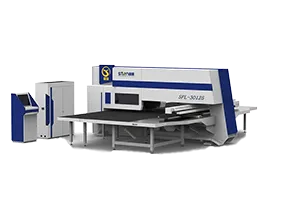
A rotating turret keeps multiple tool sets ready. The CNC control selects a station and moves the clamped blank into position. An auto-index station can rotate a compatible tool to an angle, which is useful for angled slots or other directional features. For raised forms, ask the engineer to check that the selected punch tool can achieve the required height and that the part can clear the table after forming.
The STON SF series lists ±0.1 mm machining accuracy and a maximum turret speed of 40 rpm. These describe the press. They don’t tell you where the hole will end up relative to the bend on a finished door. If that distance is critical, agree on a reference edge and measure the finished sample after cutting, transfer, punching, and bending. That check is more useful than comparing machine specifications alone. Review STON SF series technical specifications.

A transfer system must handle the part both before and after forming. A flat door blank may be easy to pick up, but a panel full of openings leaves fewer areas for vacuum cups. A raised louver can also affect how panels fit on a stack. Before choosing a gantry or robot, check the smallest blank, the heaviest part, the most open hole pattern, and any surface finish you need to protect.
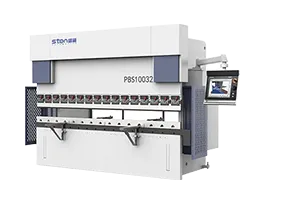
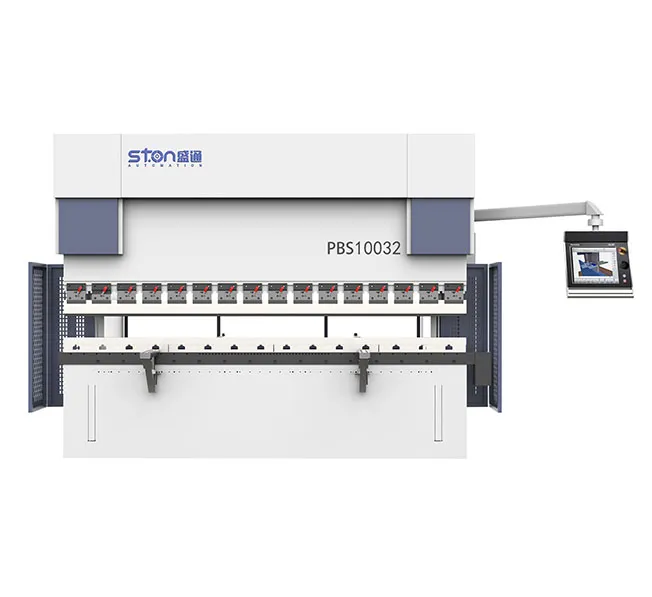
If plain parts and formed parts share the same coil, decide where they split. Plain blanks may go straight to the panel bender, the press brake, or a stack. Louvered blanks may go to the punch first. A small buffer can give the next station time to recover from a brief stop. Ask your integrator how the line responds to a missed pick or a full stack, and who is responsible for the interface with any equipment you keep. Explore STON automatic loading and unloading systems.
Imagine a cabinet door line with the cycle times below. The numbers are for planning only and are not measured STON results. If the stations work in parallel and transfers keep up, the slowest station sets the theoretical pace. Here the punch needs 30 seconds per part, so the best-case rate for this example is 120 doors per hour. A faster laser alone would not change that limit.
| Station | Illustrative time per part | Theoretical station rate |
| Coil-fed laser blanking | 18 sec | 200 parts/hour |
| Turret punch forming | 30 sec | 120 parts/hour |
| Panel bending | 24 sec | 150 parts/hour |
Real output is lower when the line stops, runs below its ideal pace, or produces rejects. If overall equipment effectiveness (OEE) were 75% against the 120-door baseline, the planning figure would be 90 good doors per planned hour. Ask suppliers to time a full batch that includes transfer and a normal changeover. Then compare material, labor, power, assist gas, tooling, and maintenance per accepted part. See STON’s cabinet line layout and cycle-time guide.
At STON, we build sheet metal automation and CNC fabrication equipment and supply factory-direct OEM/ODM configurations. We start with the part, then work back to the line. If your current bender or punch already meets the drawing, we can review whether to keep it. If you need a new line, we can evaluate the layout from coil loading to stacking, with punching or bending where your parts call for it.
For a detailed proposal, send us the following information:
Ask us to compare suitable layouts, identify the likely bottleneck, and agree on what to check in a sample run. Request a STON production line layout and factory-direct quote.
سواء أكنت تقوم بترقية خط إنتاج قائم أو تبدأ مشروعًا جديدًا، فإن STON ستخصص حلاً بنظام التحكم الرقمي للإنتاج الخاص بك.