نحن مسؤولون عن البناء-----نحن مسؤولون عن التصنيع-----نحن مسؤولون عن التدريب

Cabin walls, car doors and landing doors up to 2800 mm in hairline and coated stainless — formed straight, formed consistent, and never touched on the decorative face.
An elevator cabin is a set of long, flat, decorative panels that must sit flush against each other with no visible step, twist or wave — and whose surface is the product. Cabin wall panels, car door leaves, landing door leaves, ceilings and skirtings are typically 1.0 to 1.5 mm stainless steel in hairline, mirror, etched or PVD-coated finish, or coated steel, at lengths from 2000 to 2800 mm.
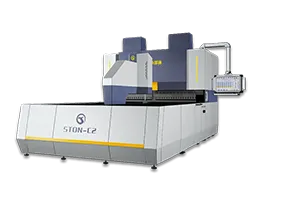
That drives three requirements no general-purpose machine meets well: straightness held over the full panel length so adjacent panels join flush; angle repeatability across a whole cabin set, because errors accumulate at every joint; and zero contact with the decorative face from blank to stack. The working set is a ليزر الألياف for blanking, a ثني الألواح باستخدام الحاسب الآلي الرقمي in D (2500) or D+ (2800) size with a cast-iron frame for the long panels, a flexible edge folding machine where panels need dead edges or arc returns, and a مكابح الضغط for stainless above the panel bender's 1.2 mm limit.
STON CNC (Qingdao Ston Mechanical Technology Co., Ltd.) is a Chinese original manufacturer of CNC panel benders and turret punch presses, founded in 2006 in Qingdao, China. All equipment described here is built inside STON CNC's own 20,000㎡ factory, from casting and heat treatment through machining, assembly and inspection. Machines carry ISO 9001 quality certification and CE marking under Machinery Directive 2006/42/EC, and are exported to more than 80 countries. View certifications and patents →
Elevator sheet metal splits into two families: long decorative panels where surface and straightness decide acceptance, and structural backing parts in heavier coated steel. The same cell handles both, with different frames and different tooling.
On a cabin wall set, four panels sit side by side. An angle error of half a degree on each becomes a visible step at the joint. Straightness of roughly 0.2 mm/m and angle accuracy of roughly ±0.5°/m are what keep the set assembling without shimming on site.
Hairline, mirror and PVD finishes cannot be reworked. Every drag across a back gauge, every glove mark, every bench edge is a rejected panel at full material cost. Vacuum pick-up moves the blank in the air; the decorative face is never in contact with anything.
This is where most enquiries go wrong. A panel bender handles stainless up to 1.2 mm at full bend length on a cast-iron frame. Many landing door specifications call for 1.5 mm. That part belongs on a press brake, or on a shorter bend length — and we say so before quoting, not after.
For elevator work, machine size is chosen by your longest cabin panel, not by average part size. Buying one size down is the most expensive saving in this industry.
Read the stainless row carefully. It is the single most common mismatch in elevator enquiries, and we would rather lose the order than supply a machine that cannot form your landing door leaf at full length.
| المعلمة | Panel bender — cast-iron frame | Panel bender — welded frame | Notes |
|---|---|---|---|
| الفولاذ المقاوم للصدأ | ≤1.2 mm | ≤1.0 mm | 1.5 mm stainless needs a press brake at full length |
| Cold-rolled / coated steel | ≤2.0 mm | ≤1.5 mm | Covers door frames and backing panels |
| Aluminium | ≤2.5 mm | ≤2.5 mm | Alloy dependent |
| Max forming size | 2500 × 1500 mm (D) / 2800 × 1500 mm (D+) | Choose by your longest cabin panel | |
| Bending height | 5 mm minimum / 170, 300 or 400 mm maximum | By configuration | |
| Bending angle | 0–180°, positive and negative | Dead edge on folding machine | |
| Angle accuracy | approx. ±0.5°/m | Decides flush joints between panels | |
| Straightness | approx. 0.2 mm/m | Critical over 2500 mm panels | |
| Dimensional accuracy | approx. ±0.1 mm/m | Verified at commissioning | |
| Utilities | Three-phase 380 V, 0.6 MPa air | Configured to destination voltage | |
Long decorative panels folded on all four sides in 1.0–1.2 mm stainless or coated steel, up to 2800 mm, where straightness and angle repeatability decide whether the cabin set assembles flush.
Roll-formed guide rails and door sill profiles, deep-drawn parts, and stainless above 1.2 mm at full bend length. Different processes, and in the case of rails, a different supplier entirely.
1.5 mm stainless landing door leaves, heavy structural brackets, sill and threshold parts, and low-volume special finishes. Nearly every elevator panel shop runs a press brake alongside the bender for exactly these.
Risk assessment follows EN ISO 12100; safety-related control functions such as light-curtain interruption and emergency stop are specified to EN ISO 13849-1. Hydraulic press brakes supplied into the EU are built against EN 12622. Machines placed on the EU market carry CE marking under Machinery Directive 2006/42/EC with the accompanying technical file. Quality management is certified to ISO 9001, and machined structural tolerances follow ISO 2768. For the finished lift installation, EN 81-20 و EN 81-50 set the safety and component test requirements your panels are designed against — the forming tolerances and joint consistency needed to satisfy them are established at the bending stage, not at final assembly.
On the machines this means fully enclosed rear fencing, protective covers on all protruding moving parts, laser guarding that halts motion when the protected zone is broken, over-tonnage protection on turret punch presses, and grating-ruler offset-load detection on panel benders.
Elevator manufacturers need all three processes. The value of getting the split right is that each machine only does what it is efficient at.
| ثني الألواح باستخدام الحاسب الآلي الرقمي | مكبس الكبح CNC | Roll forming | |
|---|---|---|---|
| Part geometry | Flat panels folded on all four sides | Any bend line, any thickness in capacity | Constant cross-section profiles only |
| Typical elevator parts | Cabin walls, car doors, ceilings, architraves | 1.5 mm stainless door leaves, brackets, sills | Guide rails, door sill profiles, frame sections |
| Stainless capability | ≤1.2 mm at full bend length | Set by tonnage and tooling | Set by the roll set |
| Max panel length | 2800 mm | 4100 mm | Effectively unlimited |
| Straightness over 2.5 m | approx. 0.2 mm/m | Depends on crowning and operator | Excellent, but fixed section |
| Decorative face protection | Vacuum pick-up, no contact | Manual handling at every step | Line-dependent |
| Changeover between cabin models | Program recall, minutes | Tool change and gauge reset | Roll set change, hours to days |
| Does STON supply it? | Yes | Yes | No — different process |
Guide rails and sill profiles are roll-formed and will keep coming from a specialist supplier. What the cell above replaces is the panel work, which is where the labour, the surface scrap and the assembly rework actually sit.
Figures below describe the direction and mechanism of the change. Actual results depend on your part mix, batch size and shift pattern — we model them against your own drawings before quoting.
| Item | Press brakes only | Panel bender cell with vacuum loading |
|---|---|---|
| Operators per 2.5 m panel | 2, plus a third for turning on long sets | 1, or unattended with truss loading |
| Handling of the decorative face | Dragged across the back gauge each bend | No contact from blank to stack |
| Angle consistency across a cabin set | Drifts between panels and shifts | Closed-loop servo, approx. ±0.5°/m |
| Straightness over the panel length | Depends on crowning and operator skill | approx. 0.2 mm/m |
| Surface scrap on hairline stainless | The single largest scrap category | Largely eliminated |
| On-site shimming at installation | Common when joints do not sit flush | Reduced by consistent panel geometry |
| Changeover between cabin models | Tool swap, gauge reset, first-article check | Program recall plus rapid compensation adjustment |
Payback logic we use with customers: (annual labour released + reduction in rework and scrap + additional saleable output) ÷ installed equipment cost. We build this with your real numbers rather than publishing a headline figure that would not match your plant.

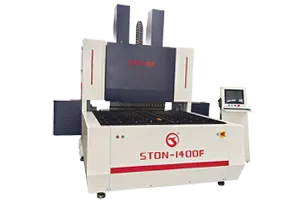
Cast-iron frame models to 2500 and 2800 mm forming length. Full-electric servo closed-loop control, ground lead screws with NSK bearings, grating-ruler offset-load detection, maintenance-free metal lubrication lines.
View press arm type →
Arc bending, dead edge and offset up to 2000 × 1500 mm. Up to 25 concurrent servo axes, 42CrMo forged blank holder, patented 360° rotating suction feeding for decorative panels.
View folding machine →
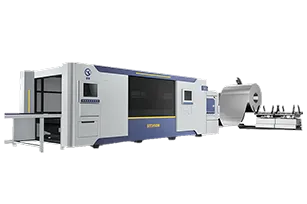
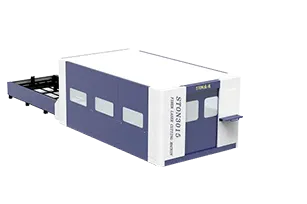
Exchange-table fiber laser with rotating platform so the next sheet loads while the current one cuts. Smooth, burr-free cuts on stainless, essential where the cut edge stays visible on an architrave.
View laser unit →
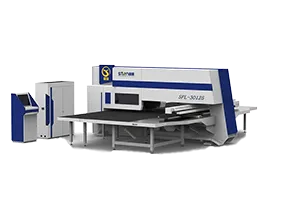
Fixing hole patterns, ventilation grilles and stiffening ribs in one clamping. Brush and steel-ball composite table protects filmed stainless; ±0.1 mm accuracy, X-axis to 2500 mm with secondary positioning to 5000 mm.
View SF series →
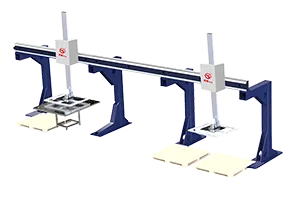
Native interface on every panel bender, compatible with most robotic arm and gantry brands. On 2.5 m cabin panels this removes the two-person lift that causes most surface damage.
View truss system →
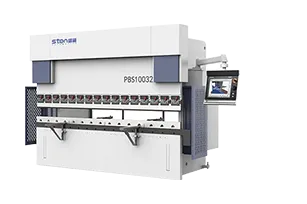
For 1.5 mm stainless landing door leaves and heavier frame parts that fall outside the panel bender window. Mechanical crowning compensation, high-precision grating ruler, multi-axis CNC back gauge.
View PBE series →Founded in 2006 and headquartered in Qingdao, one hour from major export ports and the airport. Casting, heat treatment, machining, welding, assembly and inspection all happen inside our own 20,000㎡ factory. That is why a configuration change for a 2800 mm cabin panel line does not become a six-month subcontracting problem.


Elevator projects run to building handover dates. A panel that arrives with a visible joint step is rejected on site, not in your shop, so machine accuracy and fast support are the same conversation.
Specifications on this page verified against STON engineering documentation on 4 August 2026. Forming limits are confirmed against your own drawings before quotation. Published on 4 August 2026 · Last updated 4 August 2026 · Reviewed by Vicky Xu, Head of Overseas Sales.
Two drawings decide the machine: your longest panel and your thickest stainless part. Send those and we come back within 24 hours with a model recommendation and a clear split between panel bender and press brake work.
Prefer to talk first?
WhatsApp: +86 18153226091
البريد الإلكتروني: [email protected]
Send your requirements through our secure enquiry form. Our team will reply within 24 hours.
اطلب عرض أسعار مخصصاًسواء أكنت تقوم بترقية خط إنتاج قائم أو تبدأ مشروعًا جديدًا، فإن STON ستخصص حلاً بنظام التحكم الرقمي للإنتاج الخاص بك.