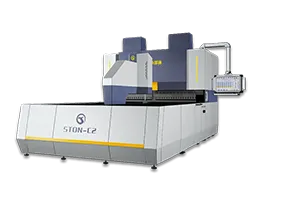
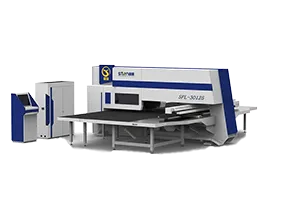
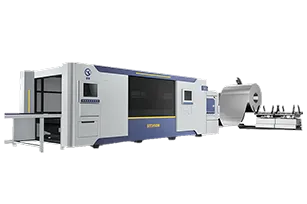
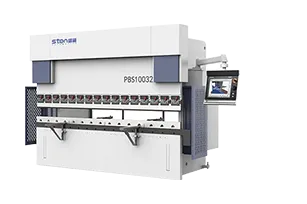
نحن مسؤولون عن البناء-----نحن مسؤولون عن التصنيع-----نحن مسؤولون عن التدريب

التثقيب البرجي عادةً ما يتفوق على الألواح التي تحتوي على العديد من الثقوب القياسية المتكررة؛; القطع بالليزر يتفوق على القطع ذات الحواف الكثيفة أو الإنتاج المنخفض أو القطع كثيرة التغيير. المتغير الحاسم هو كثافة الثقوب لكل قطعة، وليس التعقيد الإجمالي للقطعة. احسب وقت الدورة لكل ثقب مقابل تكلفة الأدوات، ثم تحقق من السُمك ومتطلبات التشكيل قبل أن تلتزم.
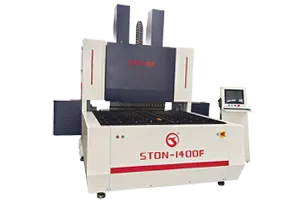
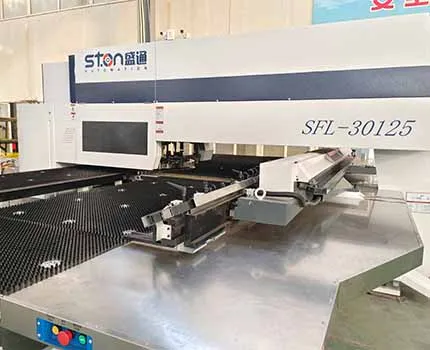
A مكبس تثقيب البرج الدوّار يدفع مثقابًا مقوى عبر الصفيحة إلى قالب مطابق. يفشل المعدن في القص. ضربة أداة واحدة، ميزة واحدة، تم — سواء كانت تلك الميزة ثقبًا دائريًا بقطر 6 مم، أو شبكة تهوية أو ضلعًا.
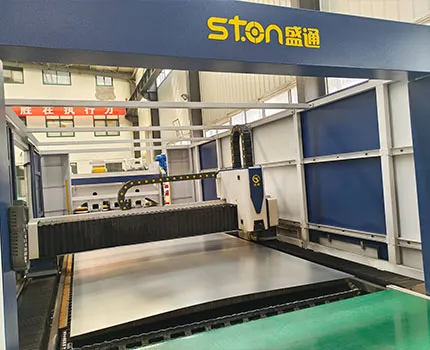
يذيب ليزر الألياف ويبخر شقًا على طول محيط مبرمج، مع غاز مساعد يزيل المواد المنصهرة. لا شيء يلمس الصفيحة. يجب أن يسير الرأس على طول المحيط الكامل لكل ميزة ينتجها.
هذا الاختلاف الوحيد يقود تقريبًا كل شيء آخر في هذه المقارنة. يدفع الثقب تكلفة ثابتة لكل ميزة ولا يهتم بعدد الميزات المتطابقة التي تتبعها. يدفع الليزر تكلفة متناسبة مع طول القطع، ولا يهتم بما إذا كان الشكل قد تم قطعه من قبل أم لا.
| البُعد | مكبس اللكم البرجي CNC | وحدة القطع بالليزر |
|---|---|---|
| محرك التكلفة | عدد الضربات لكل قطعة، بما في ذلك تغييرات الأدوات والضربات | إجمالي طول القطع وعدد الثقوب |
| أفضل هندسة | الثقوب القياسية المتكررة، والفتحات، والشبكات الهوائية، والشبكات | الكنتورات، والمنحنيات، والنصوص، والملفات الشخصية الفريدة |
| دقة تحديد الموضع النموذجية | ±0.1 ملم بناءً على دقة المعالجة المنشورة من STON SF/JT | يتم تحديدها بواسطة نظام القيادة ومصدر الليزر؛ محدودة بالكنتور بدلاً من محدودة بالأداة |
| نطاق السُمك العملي | مناسب للصفائح الرقيقة إلى المتوسطة؛ السعة محدودة بحمولة الثقب | نطاق معالجة أوسع؛ وحدات الليزر STON تقدم خيارات من 1 إلى 6 كيلووات |
| قدرة التشكيل | نعم—يمكن إتمام الشرائح والتجويف المخروطي والأضلاع والسن في نفس الإعداد | لا |
| حالة الحافة | حافة مقصوصة بجانب نتوء؛ غالباً ما يتطلب إزالة النتوءات | حافة منصهرة بدون جانب نتوء؛ قد لا تكون المعالجة الثانوية مطلوبة |
| المواد الاستهلاكية | اللكمات والقوالب والكاشطات ومواد التشحيم | الغاز المساعد والفوهات والعدسات الواقية |
| التحضير لقطعة جديدة | قد تكون هناك حاجة إلى أدوات جديدة وقد يتطلب ذلك وقت تسليم | تغيير البرنامج فقط |
| تأثير الحرارة على الصفيحة | لا يوجد | منطقة متأثرة بالحرارة موضعياً |
| الضوضاء والاهتزاز | كبير؛ يؤثر على متطلبات الحماية والأساسات | Low mechanical noise |
| Nesting Waste | Restricted by clamp dead zones and the tooling grid | Tight nesting and common-line cutting are possible |
The calculation is not complicated, and most fabricators already have the inputs sitting in their ERP.
الرقم الناتج يكون خاصاً بمزيج القطع لديك. من الشائع أن تجد نفس الورشة أن ألواح جوانب الخزانات تنتمي إلى مكبس اللكم بينما الأقواس المخصصة تنتمي إلى الليزر، وهي نتيجة مفيدة وليست محبطة.

قوة اللكم محدودة. جهاز STON SFL punch-laser combined machine publishes 300 kN (30 t) and 400 kN (40 t) options in an “O”-type closed frame, and that tonnage sets a hard ceiling on the combination of thickness, material strength and punched perimeter you can attempt in one stroke. Stainless work-hardens and needs more force than cold-rolled steel at the same gauge; aluminium needs less but galls tooling if clearances are wrong.
Laser has no equivalent mechanical ceiling within its power band. STON’s laser units are offered from 1 kW to 6 kW, and the practical limit is cut quality and speed rather than a structural limit on the machine.
There is a second thickness effect people forget. Punching thin, springy stainless below about 1 mm can distort the sheet around dense hole patterns because the material is displaced rather than removed. If your product is a 0.8 mm stainless kitchen panel with a fine perforation grid, flatness after punching becomes a genuine engineering question rather than a footnote.

This is the part of the comparison that generic process guides tend to underplay. A turret punch does not only cut. In a single automatic sequence it can produce louvers for ventilation panels, extrusions for self-tapping screws, countersinks, embossed ribs for panel stiffness, and bridge lances.
Every one of those features on a laser-cut blank becomes a separate downstream operation: another setup, another transfer, another queue, another chance for a scratched panel. For an electrical cabinet maker or an HVAC panel producer whose parts carry louvers as standard, this alone can settle the choice regardless of what the cost-per-hole arithmetic says.
Punching’s real drawbacks are not “it can’t do curves.” They are:
Laser’s real drawbacks are:
On tolerance expectations, both processes should be specified against a stated standard rather than a vague “high precision” claim. General tolerance frameworks such as ISO 2768 give you and your customer a shared vocabulary for what an unmarked dimension is allowed to do.
The comparison stops being abstract once you look at configuration data. These figures are drawn from STON’s product tables for the machines in question.
Turret punch pressesA
| المعلمة | SF Series (Servo Drive) | سلسلة JT (ميكانيكية) |
|---|---|---|
| السرعة القصوى للبرج | 40 دورة في الدقيقة | 30 دورة في الدقيقة |
| Machining Accuracy | ±0.1 mm | ±0.1 mm |
| Maximum Sheet Load | 150 kg | 150 kg |
| Combined Power Consumption | Approx. 3–5 kW | ≤2 kW |
| ضغط مصدر الهواء | 0.55 MPa | 0.55 MPa |
| مزود الطاقة | 380 V ±5% | 380 V ±5% |
| Table Structure | Brush and omnidirectional steel-ball composite | Brush and omnidirectional steel-ball composite |
| Overall Dimensions (X × Y × H) | 5200 × 5000 / 5500 / 6500 × 2230 mm | 5200 × 5000 / 5500 × 2100 mm |
The power figures are worth sitting with. A mechanical turret punch with a flywheel drive draws under 2 kW in combined consumption. A 6 kW fiber laser installation is planned around a 120 kVA supply. Over three shifts, that gap compounds into a number your finance team will notice.
Laser cutting units
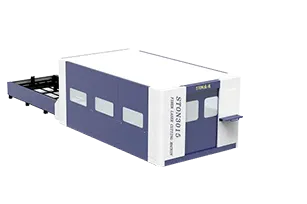
ستون‘s double-platform laser cutting machine is offered in 3015, 4015, 4020, 6020 and 6025 formats. Floor space differs sharply by configuration: the single-table 3015 occupies roughly 4500 × 2600 mm, while the exchange-table version of the same working size occupies roughly 9000 × 3100 mm. The exchange table buys you loading of the next sheet during cutting; it costs you almost double the footprint. That trade is worth deciding deliberately rather than by default.
The combined option
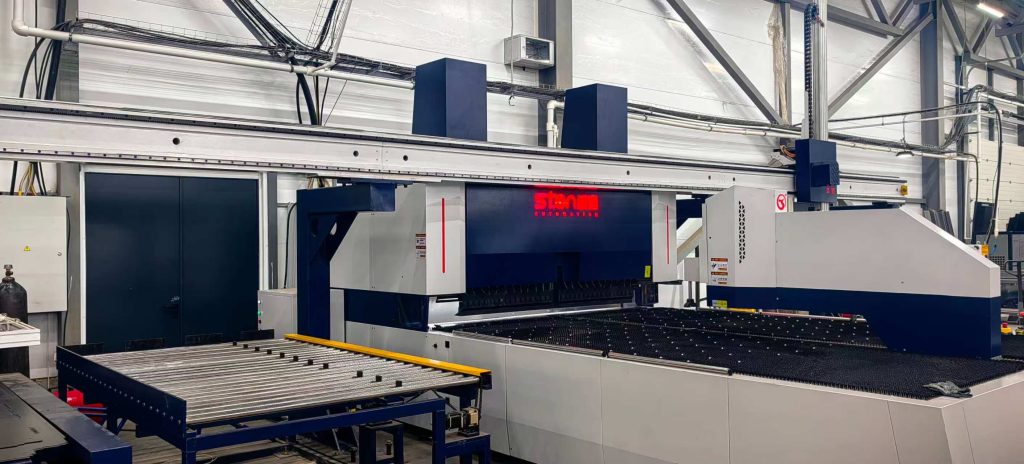
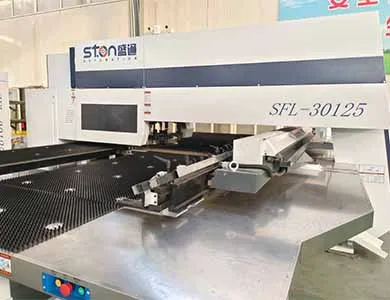
سلسلة SFL من STON servo punch-laser combined machine puts both processes on one bed with one clamping. Published configuration includes a die layout of 16A, 11B, 3C and 2D stations with two rotary stations (1B and 1C), an X-axis capacity of 2500 mm in a single position and up to 5000 mm with secondary positioning, Y-axis 1250/1500 mm, and repeatability quoted at ±0.01–0.02 mm from the double-chain rack-and-pinion drive. STON’s product data states the machine occupies roughly 40% less floor space than a separate punch press plus laser cutter, and removes the handling, second clamping and re-alignment time between the two operations.
STON does not publish list prices for these machines, because configuration, tooling package, laser power and automation change the figure substantially. Pricing is by quotation against your part drawings.
Compared with the split arrangement most fabricators run today — a standalone punch cell and a standalone laser cell, each with its own operator, its own queue and its own WIP buffer between them — an integrated approach changes the question from “which process” to “which process for which feature, within one part.”
That takes two forms. The first is the combined punch-laser machine above: punch the repeated holes and forms, laser the outer contour and the irregular cutouts, one clamping.
The second is a coil-fed line. STON’s uncoiling–leveling–laser cutting–punching–bending line runs from coil rather than pre-cut blanks, handling 0.5–2.0 mm material at 1000–1500 mm plate width with coil weight up to 10 T, and publishes leveling accuracy of ±1 mm/m² and diagonal accuracy of ≤1 mm per 2000 mm at a line speed of 0–12 m/min. For a factory producing one family of panels in volume — lockers, cabinet doors, ventilation panels — the material cost saving from buying coil instead of sheet is often larger than the process-choice saving being debated in the first place.
This only pays if your product mix is stable. A job shop quoting 400 different parts a month should not be reading this paragraph as advice.
“Laser is simply the more modern choice.” Process age is not a specification. A mechanical turret punch producing a 300-hole ventilation panel in one automatic cycle at under 2 kW is not an older way of doing something a laser does better; it is doing a different thing. The relevant question is what your parts look like, not which technology was invented last.
“We’ll decide after we buy, based on what work comes in.” Tooling is the trap here. A laser can accept a new part with a program change. A punch press may need a tool that does not yet exist in your inventory. If you buy a punch press without mapping your part families to a tooling package first, you will discover the gap on a live order. Map the tooling before the machine arrives, not after.
Q: Can a turret punch press cut an outer contour, or do I still need a laser or shear?
A: It can, by nibbling — overlapping strokes along the profile. The result has a scalloped edge and consumes a lot of strokes on a long perimeter. For straight-sided rectangular blanks it is perfectly practical. For curved or irregular outlines it is slow and the edge usually needs finishing, which is exactly the gap a punch-laser combined machine closes.
Q: Which process gives the better edge for a visible, painted panel?
A: Laser generally, because there is no burr side and no shear droop. Punched edges have a rollover on the entry side and a burr on the exit side, and on a visible edge that means deburring. If the punched features are internal holes hidden behind a cover, the edge condition rarely matters.
Q: How many tools should I budget for with a turret punch press?
A: Budget by part family, not by number. Take your top part families, list every distinct hole size, slot and form they require, and add the standard rounds and rectangles you will need for general work. Station layout matters too — a machine with dedicated rotary stations lets one tool cover slots at multiple angles instead of stocking one tool per angle.
Q: Does a fiber laser replace the punch press for thin stainless?
A: For pure cutting on thin stainless, laser avoids the distortion risk that dense punching creates in springy material. It does not replace forming. If those stainless panels need louvers or extrusions, you still need a punching capability somewhere in the process chain.
Q: What supply and utilities do I need to plan for?
A: For STON’s turret punch presses, 380 V ±5% and 0.55 MPa air. For laser cutting units, a 3 kW class installation is specified at ≤50 kVA with a 60 kVA supply recommended, and a 6 kW class at ≤100 kVA with 120 kVA recommended, plus assist gas supply and chiller provision. Confirm against the final configuration before you commission electrical work.
Q: How do I get a straight answer for my specific parts?
A: Send part drawings with material, thickness, feature list and annual volume. STON’s engineering team returns a process split and cycle-time estimate against specific machine configurations rather than a generic recommendation.
سواء أكنت تقوم بترقية خط إنتاج قائم أو تبدأ مشروعًا جديدًا، فإن STON ستخصص حلاً بنظام التحكم الرقمي للإنتاج الخاص بك.