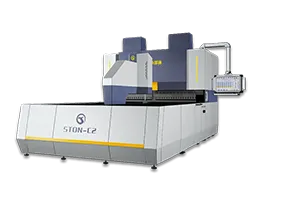
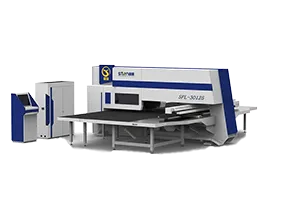
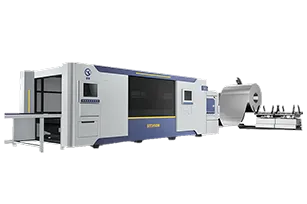
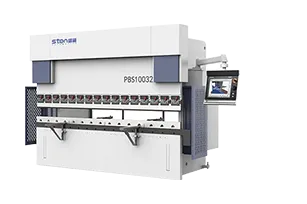
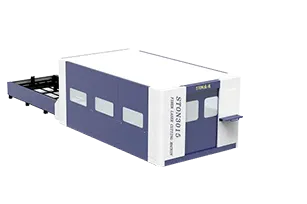
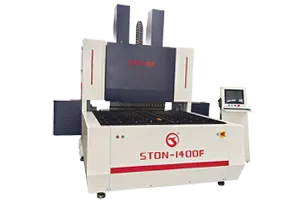
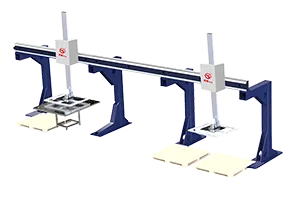
نحن مسؤولون عن البناء-----نحن مسؤولون عن التصنيع-----نحن مسؤولون عن التدريب

Choose a ثني الألواح when one part carries many short flanges and the sheet stays inside the machine’s thickness range: on ستون‘s press-arm series that means cold-rolled steel up to 2.0 mm and stainless up to 1.2 mm on a cast-iron bed. Choose a press brake when thickness, tonnage or unpredictable geometry drives the job.
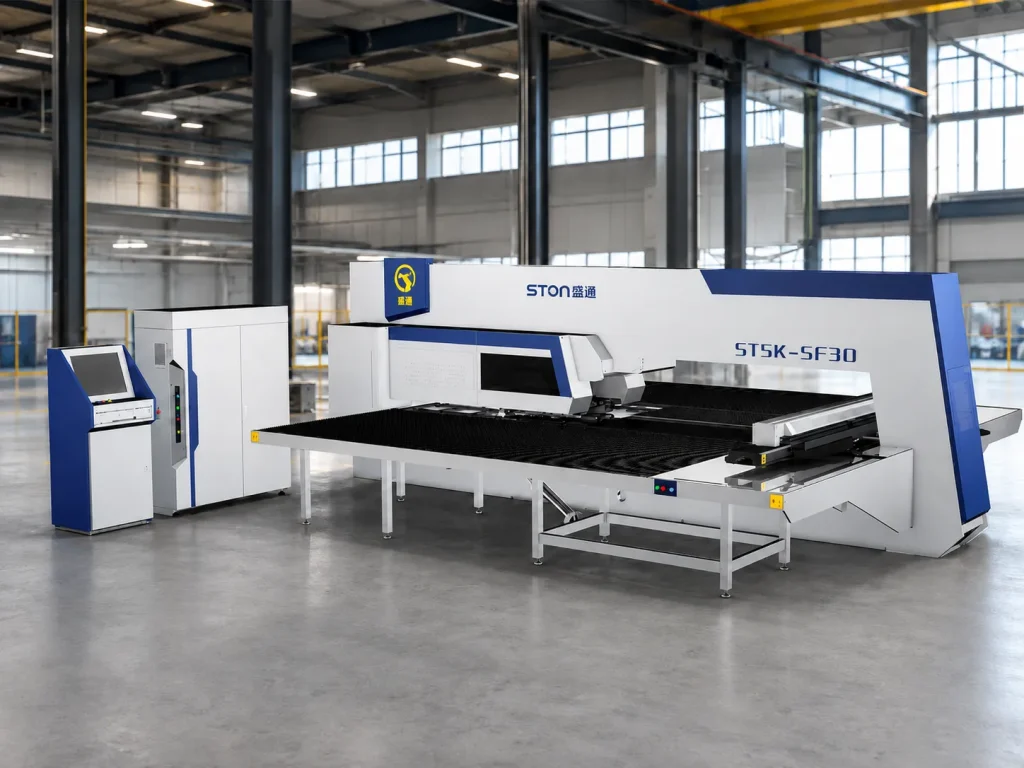
On a press brake, the part moves and the tool stays. An operator lifts the blank, positions it against the back gauge, steps on the pedal, rotates the part, repeats. Four flanges on a cabinet door means four handling cycles, and on a 2.5 m panel it means two people doing them in sync.
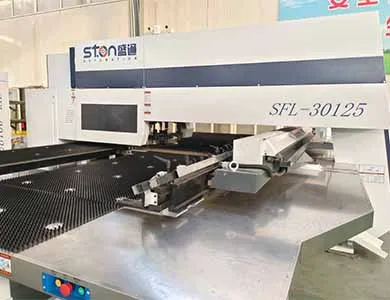
On a panel bender, the part is clamped once by a blank holder and the bending blades move around it. Up bends and down bends happen without turning the sheet over. That single mechanical fact drives almost every downstream difference: labour per part, consistency between the first piece and the five-hundredth, scratch risk on pre-coated stainless, and the amount of floor space needed for handling rather than forming.
Everything else follows from it. So does every limitation.
| Decision Dimension | ثني الألواح باستخدام الحاسب الآلي الرقمي (STON Press-Arm Series) | CNC Press Brake (STON PBS / PBE) |
|---|---|---|
| Forming Principle | Blank holder clamps once; bending blades form each edge | Punch descends into a V-die, completing one bend per stroke |
| Handling per Part | One load and one unload | One handling cycle per bend line |
| Max. Thickness at Full Bend | Welded bed: CR 1.5 mm / SS 1.0 mmCast bed: CR 2.0 mm / SS 1.2 mm | Determined by tonnage: 63–320 t across the published range |
| Max. Working Length | 1000–2800 mm, depending on the model | 1500–4100 mm, depending on the model |
| Bend Height Range | Minimum: 5 mmMaximum options: 170 / 300 / 400 mm | Limited by tooling and open height rather than machine geometry |
| Minimum Four-Sided Inner Dimension | 140 × 190 mm | No equivalent constraint |
| Angle Range | 0–180° | Determined by tooling |
| Published Angle Accuracy | Approx. ±0.5°/m | Closed-loop grating scale with mechanical crowning compensation |
| Published Dimensional Accuracy | Approx. ±0.1 mm/mStraightness: approx. 0.2 mm/m | Depends on tooling, back-gauge programming, and the operator |
| Changeover Between Parts | Program recall; 15 servo axes reposition automatically | Tool change and back-gauge reprogramming |
| Operator Skill Dependency | Low after training | High and remains operator-dependent |
| Machine Weight | Lighter structure with a larger footprint | 4,500 kg for 63/1500 model to 19,000 kg for 320/4100 model |
Most machine-builder content on this topic argues one direction and stops. Compared with the general-purpose bending packages usually quoted against a ثني الألواح, the panel bender genuinely does win on enclosure-type work — and there are four situations where recommending one would be wrong.
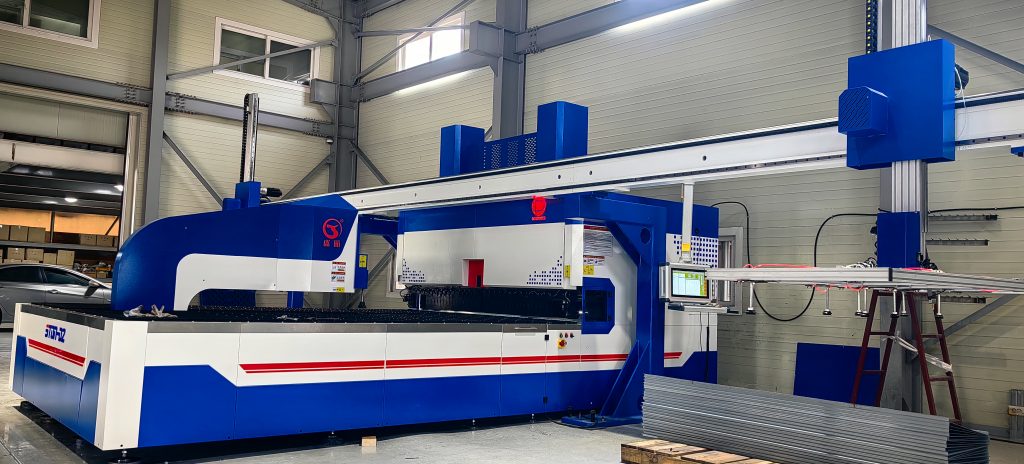
Plants upgrading from manual bending often frame this as replacement. In practice almost nobody scraps their press brakes when a panel bender arrives. The press brake keeps the prototypes, the repair parts, the thick brackets, the odd trapezoid nobody drew properly, and the remake when a customer changes a flange three days before shipment. What changes is the ratio: the panel bender absorbs the repeating 70–80% of enclosure volume, and the press brake stops being the bottleneck for everything else.
Budget for both. Sequence them by which one is currently constraining output.
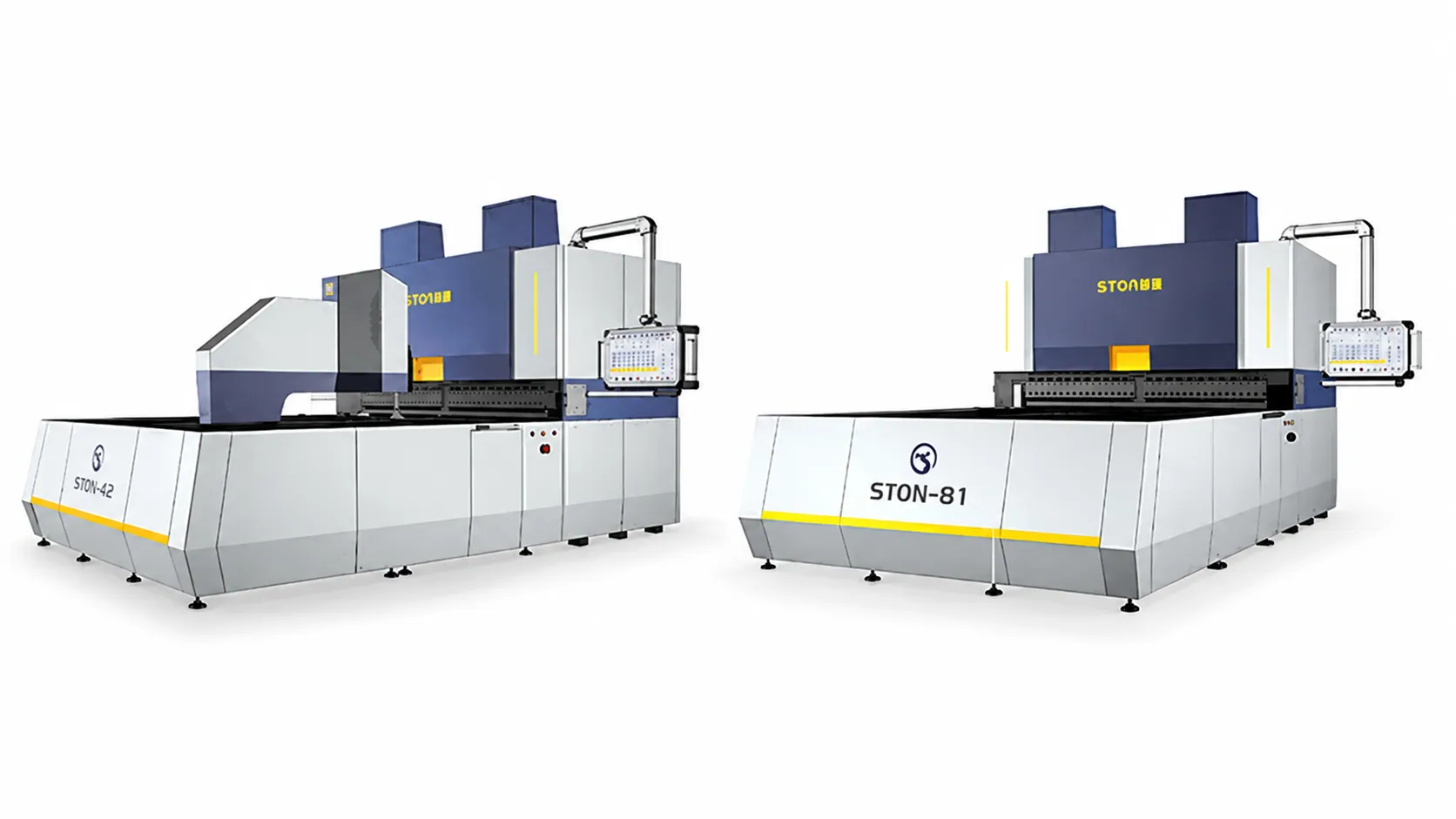
The press-arm series runs from A (1000 × 1000 mm forming size) through A+ (1200), B (1400 × 1250), B+ (1600 × 1250), C (2000 × 1500), D (2500 × 1500) to D+ (2800 × 1500). Every model in the standard configuration carries 15 servo axes.
Bed construction is the specification that changes the answer more than model size does:
Common working parameters across the series: bending angle 0–180°, minimum bending height 5 mm, angle accuracy approximately ±0.5°/m, straightness approximately 0.2 mm/m, dimensional accuracy approximately ±0.1 mm/m. Utilities are three-phase 380 V with a 0.6 MPa air supply.
For thick-plate work inside the sheet range, the W axis can be given a dedicated motor, or the W/X/Z axes upgraded to a three-motor drive with a thickened body. Auxiliary blades — upper, lower or both — can be specified and cut to length for localised short bends on a part. Where a workpiece needs to be lifted during forming, a C-axis lifting configuration and customised clamping are defined before build, not after.
Dead edges, arcs and offsets sit slightly outside this family. Those belong on the flexible edge bending machine, which forms to a 100 mm maximum bend height with a 4 mm minimum, in 1200, 1600 and 2000 sizes.
This is the part that surprises European and Middle Eastern buyers late in a project.
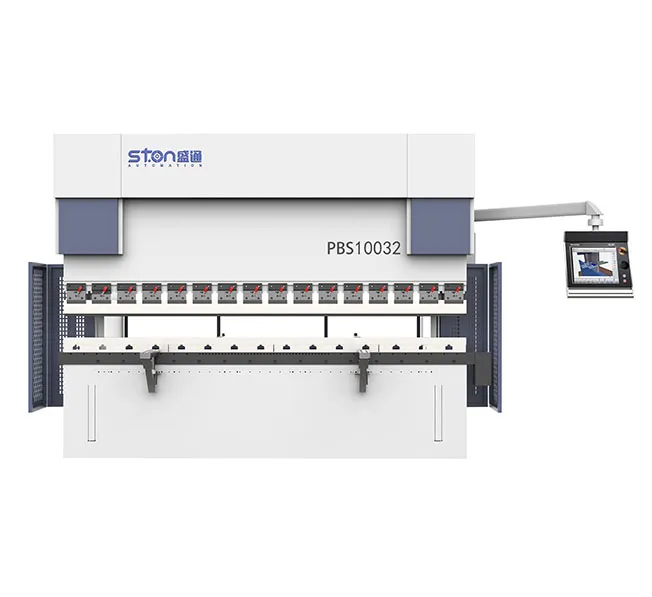
A press brake is an open-tool machine with a moving beam and an operator’s hands near the die line. Under the EU Machinery Directive 2006/42/EC, presence-sensing protection and safe control architecture are not optional extras. EN 12622 covers hydraulic press brake safety specifically, EN ISO 16092 the wider press family, and EN ISO 13849-1 the performance level required of the safety control system. ستون‘s press brakes ship with a laser protection device that stops the beam when the monitored zone is broken.
A panel bender is a different risk profile: the forming zone is enclosed, and the operator’s role is loading and unloading rather than positioning during the stroke. Guarding is fencing and interlocks rather than presence sensing at the tool line. It does not remove the CE obligation, but it changes what the risk assessment under EN ISO 12100 concludes, and it usually changes the insurance and operator-training picture too.
Ask any supplier which of these standards their declaration of conformity references. A vague “CE certified” answer is worth following up on.
Q: Can a panel bender fully replace our press brakes?
A: Not in any plant we have configured. It replaces the repeating enclosure volume. Prototypes, thick brackets, oversized single bends and last-minute remakes stay on the press brake. Plan the panel bender as the machine that unloads your press brakes, not as the one that retires them.
Q: What thickness can a panel bender actually handle?
A: On ستون‘s press-arm series, 1.5 mm cold-rolled and 1.0 mm stainless with a welded bed, or 2.0 mm and 1.2 mm with a cast-iron bed, at full bend. Aluminium runs slightly higher. If your parts sit right at these numbers, request a forming trial on your own material rather than relying on the table, because temper and coating both affect the result.
Q: We make electrical cabinets. Which machine first?
A: Usually the panel bender, provided your doors and side panels stay within the thickness limits and above the 140 × 190 mm minimum. Cabinet work is the archetypal case: many short flanges, four sides, high repeat, and a surface finish that suffers from repeated manual handling.
Q: How much floor space does each need?
A: A press brake occupies less machine footprint but needs handling and staging space around it, plus room for a second operator on long parts. A panel bender occupies more of a fixed cell and less variable space. Compare total cell area, not machine dimensions on the drawing.
Q: What does either machine cost?
A: STON does not publish list prices for panel benders or press brakes, because both are configured per application — bed type, blade height, axis upgrades, tooling, automation interface. Request a quotation against your part drawings. Any supplier giving you a firm figure before seeing your geometry is quoting a catalogue machine, not your machine.
Q: Can we add automatic loading later?
A: Yes on both families. STON’s panel benders and press brakes retain a native loading and unloading interface compatible with most robot arms and gantry systems. Retrofitting is far easier when the interface exists from day one, so specify it at purchase even if you install the robot two years later.
Q: Which is easier to staff?
A: The panel bender, decisively. Press brake accuracy tracks operator experience, and experienced brake operators are hard to hire in most markets. A panel bender moves that skill into the program.
سواء أكنت تقوم بترقية خط إنتاج قائم أو تبدأ مشروعًا جديدًا، فإن STON ستخصص حلاً بنظام التحكم الرقمي للإنتاج الخاص بك.